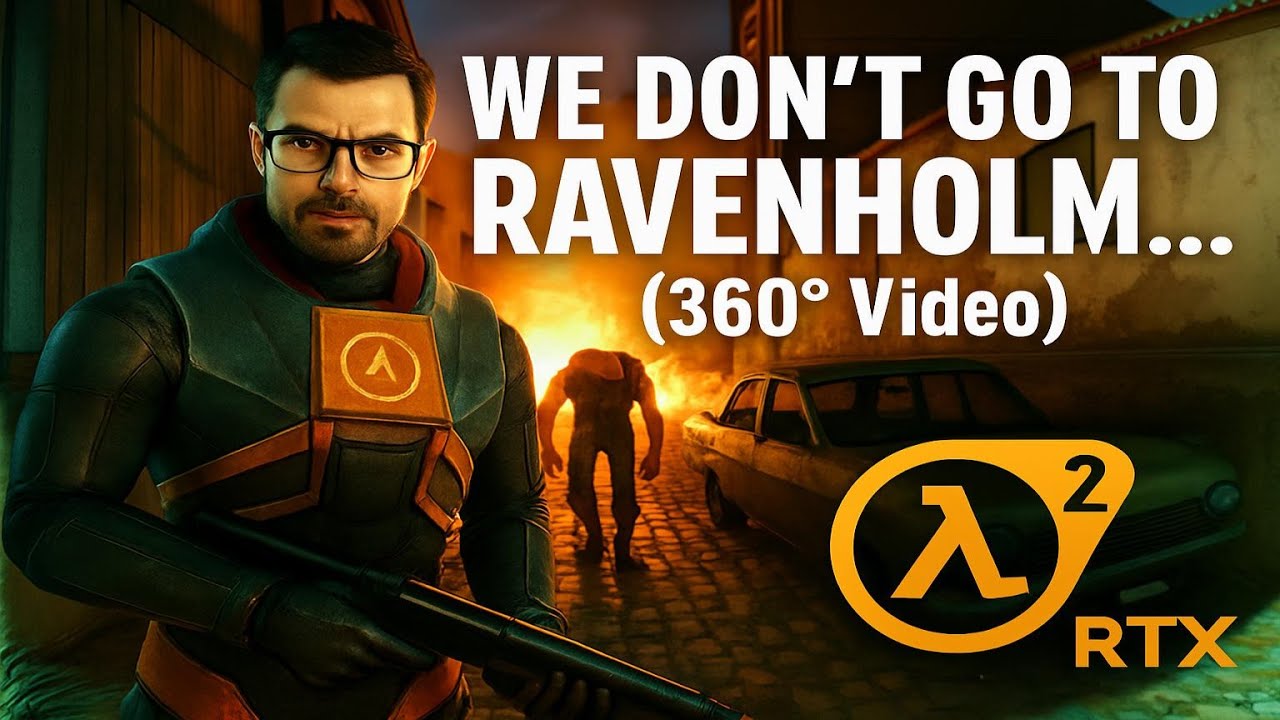
360° Half-Life 2 RTX
Playlist by TheGamerBay
Description
Half-Life 2 remains one of the most influential titles in the history of first-person shooters, celebrated for its physics-based gameplay, immersive storytelling, and dystopian atmosphere. Two decades after its initial release in 2004, the game is receiving a dramatic technological overhaul known as Half-Life 2 RTX. This project is not a mere resolution bump or a simple texture pack; it is a comprehensive remastering effort that leverages the full capabilities of modern graphics hardware to reimagine Valve’s classic for the current generation. Developed by Orbifold Studios—a collective formed by four of the community's top modding teams—and supported by NVIDIA, this project serves as a showcase for the transformative power of ray tracing and community collaboration.
The technological backbone of this remaster is NVIDIA’s RTX Remix, a modding platform designed to streamline the process of upgrading older DirectX 8 and 9 games with state-of-the-art visual features. The defining characteristic of Half-Life 2 RTX is the implementation of full ray tracing, often referred to as path tracing. Unlike traditional rasterization used in the original game, which relies on "baked" or pre-calculated lighting that does not change dynamically, path tracing simulates the physics of light in real-time. In this new version, light bounces off surfaces, casts realistic soft shadows, and reflects accurately off glass, water, and metal. Consequently, the grim, industrial aesthetic of City 17 is rendered with a level of depth and atmospheric realism that was impossible to achieve in 2004.
However, the improvements extend far beyond lighting. The developers at Orbifold Studios are painstakingly rebuilding the game’s assets to match the fidelity of the new lighting engine. This involves the use of Physically Based Rendering (PBR), a texturing method that ensures materials interact with light just as they would in the real world. In the RTX version, the rough concrete of the Citadel walls, the sleek metal of the Combine technology, and the fabric of the citizens' clothes possess distinct tactile qualities. The polygon counts of models have been increased drastically—by over twenty times in some cases—smoothing out the jagged edges of the early 2000s geometry. For instance, the iconic HEV suit and the magnifying lenses in Dr. Kleiner’s lab have been remodeled with intricate detail to withstand scrutiny at 4K resolution.
To manage the immense computational demand of path tracing, Half-Life 2 RTX utilizes advanced AI-driven technologies. The integration of NVIDIA’s DLSS (Deep Learning Super Sampling) 3.5 allows the game to upscale lower-resolution images and generate intermediate frames, ensuring smooth performance on supported hardware. Furthermore, the inclusion of Ray Reconstruction helps to denoise the image, creating sharp, high-fidelity lighting effects without the visual artifacts that often accompany real-time ray tracing. These technologies are essential, as fully path-traced environments are incredibly taxing on graphics processing units.
Ultimately, Half-Life 2 RTX represents a convergence of nostalgia and futurism. It preserves the core gameplay, level design, and narrative pacing that made the original a masterpiece, ensuring that the "feel" of the game remains authentic to Valve’s vision. Yet, visually, it rivals modern AAA blockbusters. By placing high-end tools in the hands of passionate community creators, the project demonstrates how legacy software can be preserved and evolved. It offers veterans a reason to return to the suppression field of City 17 while providing newcomers with a visually stunning entry point into Gordon Freeman’s saga.
Published:
Jan 22, 2026