Super Mario World 2: Yoshi's Island
Nintendo (1995)
Description
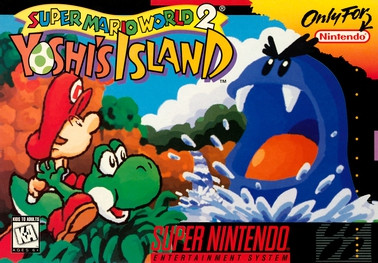
Released in 1995 for the Super Nintendo Entertainment System (SNES), *Super Mario World 2: Yoshi's Island* stands as a pivotal moment in the history of platforming video games. Developed by Nintendo EAD and published by Nintendo, the game serves technically as a prequel to the entire *Super Mario* franchise, despite its numbering suggesting a direct sequel to the 1990 launch title *Super Mario World*. It is widely celebrated for its radical departure from the visual and gameplay norms of its time, introducing a coloring-book aesthetic and mechanics that would define the *Yoshi* series for decades to come.
The narrative premise of the game is distinct from the typical "rescue the princess" trope of the *Mario* series. The story begins with a stork delivering twin brothers, Baby Mario and Baby Luigi, to their parents in the Mushroom Kingdom. Mid-flight, the stork is ambushed by Kamek, an evil Magikoopa who has foreseen that the babies will cause trouble for his master, Baby Bowser. Kamek succeeds in kidnapping Baby Luigi and the stork, but Baby Mario falls from the sky, landing on the back of a green Yoshi on Yoshi's Island. Acknowledging a psychic bond between the brothers, the Yoshi clan decides to help Baby Mario rescue his brother. The game is structured as a relay race, with different colored Yoshis carrying Baby Mario through various levels before passing him to the next Yoshi at the end of each stage.
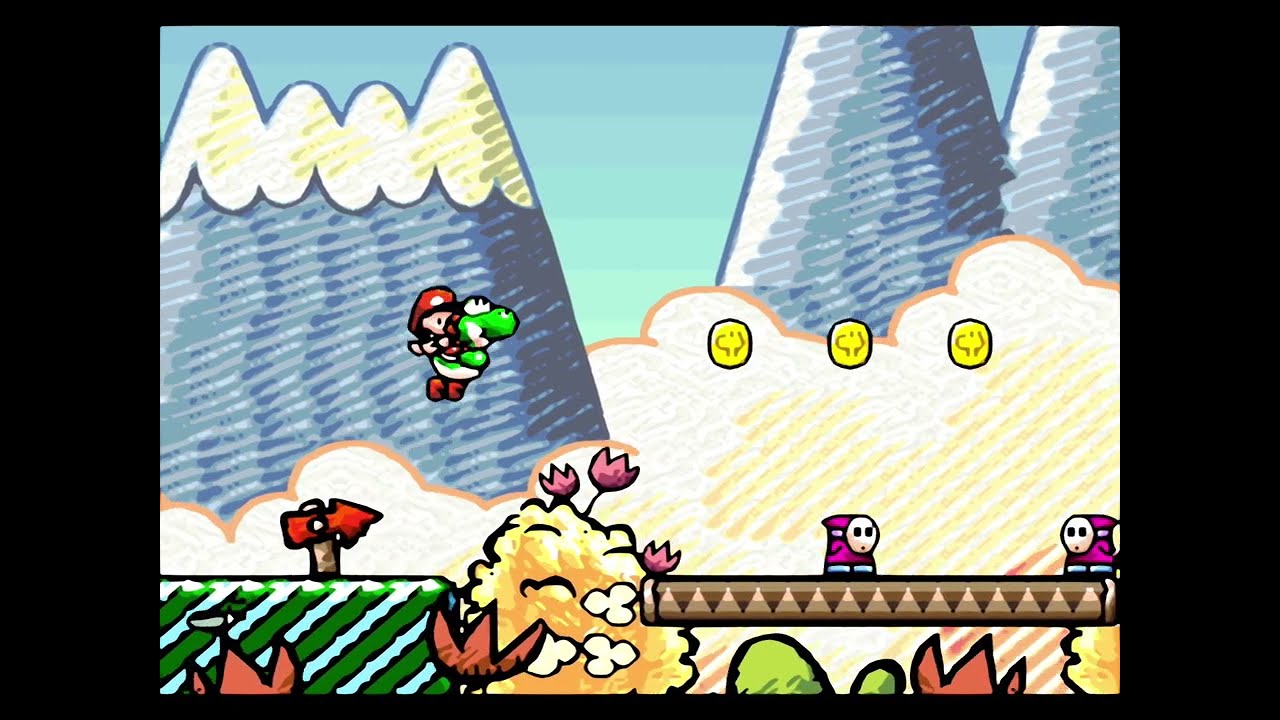
Gameplay in *Yoshi's Island* shifts the focus from Mario's acrobatics to Yoshi's unique dinosaur abilities. While Yoshi can run and jump, his signature move is the "flutter jump," which allows him to kick his legs in mid-air to gain extra height and distance, providing a level of aerial control previously unseen in the genre. Combat is centered on Yoshi's long tongue, which he uses to swallow enemies. Once swallowed, enemies can be spat out as projectiles or digested to produce eggs. These eggs trail behind Yoshi and can be thrown at enemies, switches, and obstacles. The egg-throwing mechanic utilizes a targeting cursor that moves back and forth, requiring the player to time their throws precisely—a mechanic that added a layer of skill and puzzle-solving to the platforming.
The health system is another major innovation. Instead of a traditional life bar or hit points, the game utilizes a "countdown timer" mechanic. When Yoshi is hit by an enemy, he does not take damage directly; instead, Baby Mario is knocked off his back and floats away in a bubble, crying. A timer starts counting down (defaulting to 10 seconds, expandable to 30), and the player must retrieve Baby Mario before the counter reaches zero and Kamek's minions kidnap him. This system alleviates the frustration of instant death while creating panic-inducing moments of urgency.
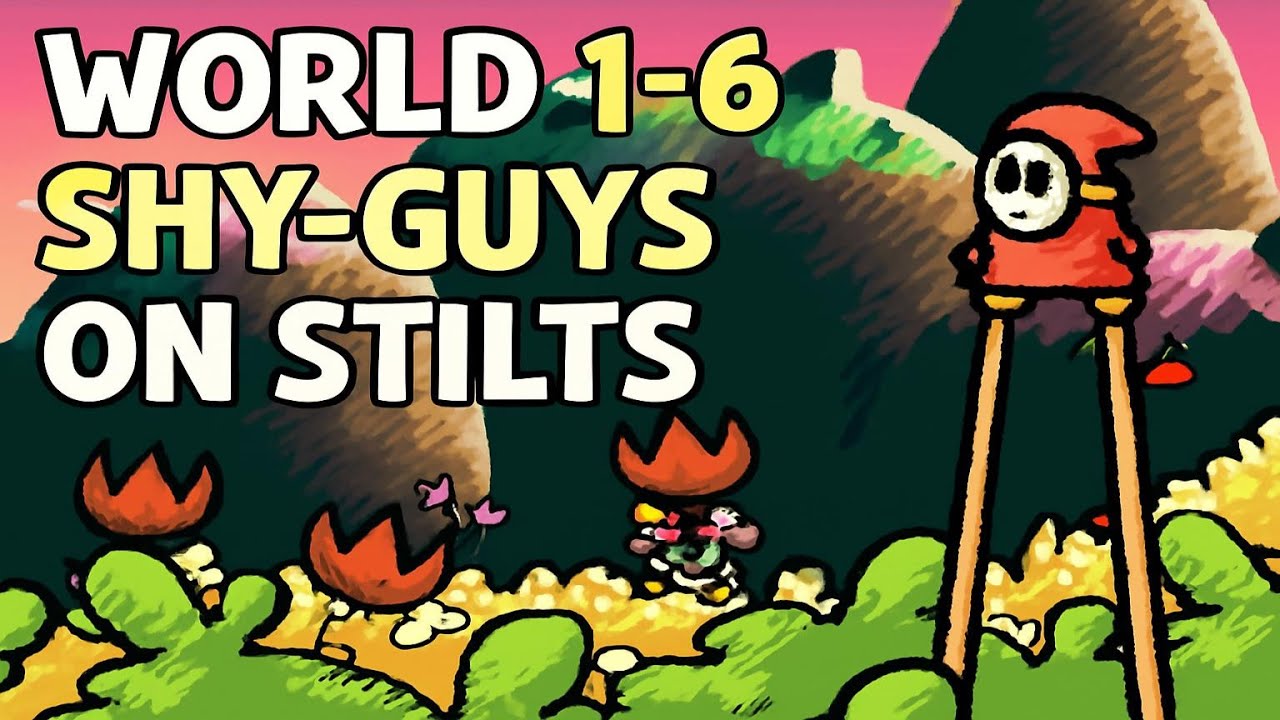
Visually, *Yoshi's Island* is famous for its defiance of the era's trends. During development, there was internal pressure at Nintendo to utilize pre-rendered 3D graphics, similar to the commercially successful *Donkey Kong Country*. However, producer Shigeru Miyamoto and his team rejected this, opting instead for a "hand-drawn" aesthetic. The world appears as if drawn with crayons, markers, and felt-tip pens, featuring pastel colors and wobbly outlines. This artistic choice ensured the game aged gracefully, avoiding the uncanny valley often associated with early CGI.
Despite the "low-tech" look, the game was a technological powerhouse powered by the Super FX 2 microchip built into the cartridge. This extra processing power allowed for advanced sprite scaling, rotation, and stretching effects that the standard SNES hardware could not handle. These effects were used creatively in boss battles—such as a giant Baby Bowser approaching from the background—and in level obstacles like falling walls and rolling platforms, creating a sense of scale and dynamism that felt immense for a 16-bit title.
The game's audio was composed by Koji Kondo, who delivered a soundtrack that matched the game's whimsical and slightly tropical tone. The music ranges from the playful and upbeat "Athletic Theme" to the soothing lullaby of the map screen, further cementing the game's storybook atmosphere.
The development was led by directors Takashi Tezuka, Shigefumi Hino, and Toshihiko Nakago, with Miyamoto serving as producer. While the original SNES version was developed solely by Nintendo EAD, a later port for the Game Boy Advance, titled *Yoshi's Island: Super Mario Advance 3*, involved Nintendo R&D2. This port included additional levels but slightly altered the visual effects due to hardware differences.
Upon release, *Super Mario World 2: Yoshi's Island* received universal acclaim. Critics praised its level design, which encouraged exploration through the collection of red coins, flowers, and stars to achieve a perfect score of 100 on each stage. This completionist aspect added significant replay value. The game is frequently cited as one of the greatest video games of all time and established Yoshi as a major Nintendo franchise lead, spawning sequels like *Yoshi's Story*, *Yoshi's Island DS*, and *Yoshi's Woolly World*. Its legacy lies in its proof that strong art direction and inventive mechanics are timeless, allowing it to stand apart from the mainline *Mario* games as a masterpiece in its own right.
Release Date: 1995
Genres: platform
Developers: Nintendo EAD, Nintendo R&D2
Publishers: Nintendo