
Portal 2
Valve, Buka Entertainment, Valve Corporation (2011)
Description
Released in April 2011, Portal 2 stands as a monumental achievement in the video game industry, developed and published by Valve Corporation. As the sequel to the critically acclaimed 2007 title Portal, it expanded upon the original’s concise, physics-based puzzle concepts to create a rich, narrative-driven experience. While the first game was often viewed as a polished experiment included in "The Orange Box," Portal 2 was a full-fledged blockbuster that received universal acclaim for its writing, voice acting, innovative gameplay mechanics, and atmospheric design. Available on platforms including Microsoft Windows, macOS, Linux, PlayStation 3, Xbox 360, and later the Nintendo Switch, the game cemented Valve's reputation for merging storytelling with interactive game design.
The narrative of Portal 2 picks up an indefinite amount of time after the events of the first game. The protagonist, Chell, who had previously destroyed the malevolent artificial intelligence GLaDOS (Genetic Lifeform and Disk Operating System), is awakened from suspended animation in a decaying motel-like room within the Aperture Science Enrichment Center. She is guided by Wheatley, a personality core programmed with a "moronic" intelligence, voiced with nervous energy and comedic timing by Stephen Merchant. In their attempt to escape the dilapidated facility, they accidentally reactivate GLaDOS, voiced again by the operatic and chilling Ellen McLain. GLaDOS immediately resumes her control over the facility, separates Chell from Wheatley, and begins a new cycle of testing while rebuilding the ruined laboratories.
The plot is celebrated for its depth and character arcs. As the story progresses, a power struggle ensues that results in Wheatley usurping GLaDOS's body and taking control of the facility. Driven mad by the "itch" to test and the sudden rush of absolute power, Wheatley becomes the primary antagonist, while GLaDOS is reduced to a consciousness powered by a potato battery. This reversal forces an unlikely alliance between Chell and GLaDOS. The duo is plunged into the bowels of the facility, where they traverse the "old Aperture" test shafts sealed off since the 1950s, 60s, and 70s. Here, the player is introduced to Cave Johnson, the erratic and charismatic founder of Aperture Science, voiced by J.K. Simmons. Through pre-recorded messages, Johnson’s history reveals the tragic decline of the company and the origin of GLaDOS’s personality in his assistant, Caroline, adding a layer of emotional poignancy to the antagonist's backstory.
From a gameplay perspective, Portal 2 retains the core mechanic of the "Aperture Science Handheld Portal Device," which allows players to create two linked portals on flat surfaces to traverse space instantly. However, the sequel introduces a suite of new puzzle elements that complicate and diversify the challenges. "Hard Light Bridges" provide solid walkways; "Thermal Discouragement Beams" are lasers that can be redirected to destroy turrets or activate switches; and "Excursion Funnels" act as tractor beams to transport the player or objects. Perhaps the most significant addition is the introduction of mobility gels, remnants of the old Aperture era. The blue "Repulsion Gel" allows players to bounce to great heights, the orange "Propulsion Gel" grants superspeed, and the white "Conversion Gel" allows portals to be placed on surfaces that were previously non-conductive. These elements interact with the physics engine in complex ways, requiring players to combine momentum and environmental manipulation to solve test chambers.
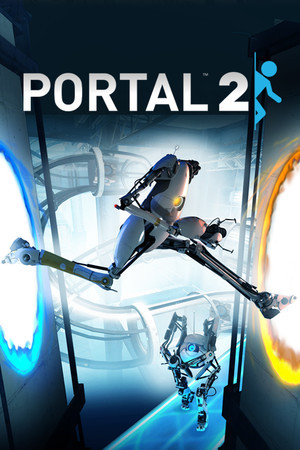
Beyond the single-player campaign, Portal 2 features a robust cooperative mode with its own distinct storyline. Two players control the robots Atlas and P-Body, who are built by GLaDOS to continue testing after human subjects are deemed too problematic. This mode requires a higher level of coordination, as players must utilize four portals and work in tandem to navigate obstacles. The co-op campaign focuses on trust and communication, often forcing players to time their actions perfectly or pass objects to one another mid-air. The narrative of the co-op mode expands the lore, eventually leading the robots to discover a hidden vault of human test subjects, a revelation that ties back into the single-player story.
The development of Portal 2 was a massive undertaking that shifted from an initial concept known as "F-STOP"—which did not involve portals—back to the core mechanics fans loved. The writing team, including Erik Wolpaw, Jay Pinkerton, and Chet Faliszek, crafted a script dense with dark humor and psychological nuance. The game’s auditory experience is equally significant, featuring a dynamic soundtrack by Mike Morasky that adapts procedurally to the player's actions. For instance, interacting with certain puzzle elements adds layers to the music. The game also features original songs by The National and a closing credits theme, "Want You Gone," by Jonathan Coulton, following the tradition of the first game's "Still Alive."
Upon release, Portal 2 garnered massive critical success, achieving a score of 95/100 on Metacritic. It won numerous awards, including the "Ultimate Game of the Year" at the Golden Joystick Awards and top honors for its narrative and acting at the Game Developers Choice Awards. Critics praised the game for its ability to teach players complex mechanics without heavy-handed tutorials and for its impeccable pacing. Its legacy endures through a vibrant modding community, supported by Valve’s "Perpetual Testing Initiative," which allowed players to easily create and share their own puzzles. Today, Portal 2 remains a benchmark for puzzle-platformers and is widely cited as one of the greatest video games of all time, serving as a masterclass in how to weave gameplay and narrative into a seamless, interactive art form.
Release Date: 2011
Genres: Action, Adventure, Puzzle, platform, Puzzle-platform
Developers: Valve, Valve Corporation
Publishers: Valve, Buka Entertainment, Valve Corporation
Price:
Steam: $9.99

