
Rayman: Raving Rabbids
Ubisoft, Buka Entertainment, Licomp Empik Multimedia (2006)
Description
Video games often experience shifts in direction during development, but few are as drastic or as culturally impactful as the transformation of *Rayman: Raving Rabbids*. Released in 2006, the title serves as a pivotal point in Ubisoft’s history, marking the divergence of the *Rayman* franchise and the birth of the Rabbids—a spin-off phenomenon that would eventually eclipse its parent series in global popularity. While it carries the name of the limbless hero, the game is best understood not as a traditional platformer, but as a chaotic, humor-driven collection of minigames designed to showcase the motion-control capabilities of the Nintendo Wii.
The development history of the game is a tale of adaptation and compromise. Originally conceived by Michel Ancel and his team at Ubisoft Montpellier as a traditional 3D platformer titled *Rayman 4*, the project was intended to be a darker, combat-focused adventure where Rayman would fight off an invasion of zombie-like rabbits. However, upon receiving early development kits for Nintendo’s upcoming console, the Wii (then codenamed "Revolution"), the team realized the hardware's motion controls offered a unique opportunity for disparate, shorter gameplay experiences rather than a singular open-world epic. Facing tight deadlines to meet the console's launch, the platforming elements were largely scrapped in favor of a party-game structure. The development duties were shared across Ubisoft's global network, with Ubisoft Montpellier leading, while Ubisoft Sofia handled the PC version and Ubisoft Casablanca developed the Nintendo DS iteration. Handheld versions were also outsourced, such as the Game Boy Advance version developed by Visual Impact Productions.
The premise of the final game is absurdly simple, relying on slapstick comedy rather than narrative depth. Rayman is having a picnic with the children of his friend Globox when they are suddenly ambushed by the Rabbids—crazed, screaming, lagomorph-like creatures who have risen from the ground to enslave them. Rayman is captured and thrown into a gladiatorial arena. To survive, he must participate in a series of trials to entertain the Rabbids. The story is structured around "days," with Rayman imprisoned in a bleak cell between matches. As he completes trials, he earns plungers—initially a joke prize, but eventually the tools he uses to construct a ladder and make his escape. The tone is irreverent, defined by the Rabbids' gibberish screams (the iconic "Bwah!") and their misuse of mundane human objects like plungers and toilet brushes.
Gameplay on home consoles (Wii, PlayStation 2, Xbox 360, and PC) consists of over 75 minigames split into two main modes: Story Mode and Score Mode. In Story Mode, the player must pass four trials to unlock a final "Boss" minigame for the day. These trials are diverse and frantic, often utilizing the Wii Remote’s motion sensors to mimic physical actions. Players might find themselves pumping the controller to run a race, swinging it to throw a cow, or pointing it at the screen to shoot plungers at incoming enemies in "on-rails" first-person shooter sections. A standout feature of the game is its rhythm-based challenges, where Rayman must dance to high-pitched, sped-up covers of pop songs like "Girls Just Want to Have Fun" and "Misirlou," requiring the player to shake the controller in time with the music.
It is important to note the stark differences between platform versions. The Wii version is widely considered the definitive experience due to the motion controls being integral to the design. Ports to the PlayStation 2, Xbox 360, and PC (published in various regions by partners like Buka Entertainment in Russia and Licomp Empik Multimedia in Poland) adapted these actions to button presses and analog sticks, which critics noted often drained the chaotic fun from the experience. Conversely, the handheld versions retained the original platforming DNA. The Game Boy Advance version, for instance, is a traditional 2D side-scroller that bears little resemblance to the console party game, while the Nintendo DS version attempts a hybrid of platforming and touch-screen minigames.
Critically, *Rayman: Raving Rabbids* was a commercial success, particularly on the Wii, where it was celebrated as one of the best launch titles for demonstrating the system's potential. Reviewers praised the character design of the Rabbids, the eclectic soundtrack by Mark Griskey, and the genuine humor. However, the game polarized long-time fans of the series, many of whom were disappointed by the cancellation of the "true" *Rayman 4* platformer.
The legacy of *Rayman: Raving Rabbids* is massive. The Rabbids became instant pop-culture icons, appearing in television shows, merchandise, and a long line of sequels that eventually dropped Rayman from the title entirely. For years, Rayman was relegated to a supporting role in his own franchise, only returning to prominence with *Rayman Origins* in 2011. Ultimately, *Raving Rabbids* stands as a time capsule of the mid-2000s motion-control boom—a game that sacrificed a hero's traditional adventure to launch a brand new, chaotic mascot for the casual gaming era.
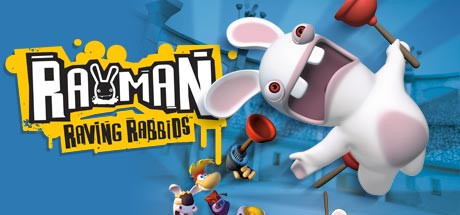
Release Date: 2006
Genres: Action, Adventure, Fantasy, platform, party, Rail shooter, Party game, Mini-games
Developers: Ubisoft Bulgaria, Ubisoft Montpellier, Ubisoft Sofia, TransGaming, Ubisoft Casablanca, Visual Impact Productions, [1]
Publishers: Ubisoft, Buka Entertainment, Licomp Empik Multimedia


